The Faces that Launched 9,622 Zoom Classes
The Office of the Vice Provost for Teaching, Learning, and Innovation has been key to the success of online classes, helping instructors take full advantage of the digital format.
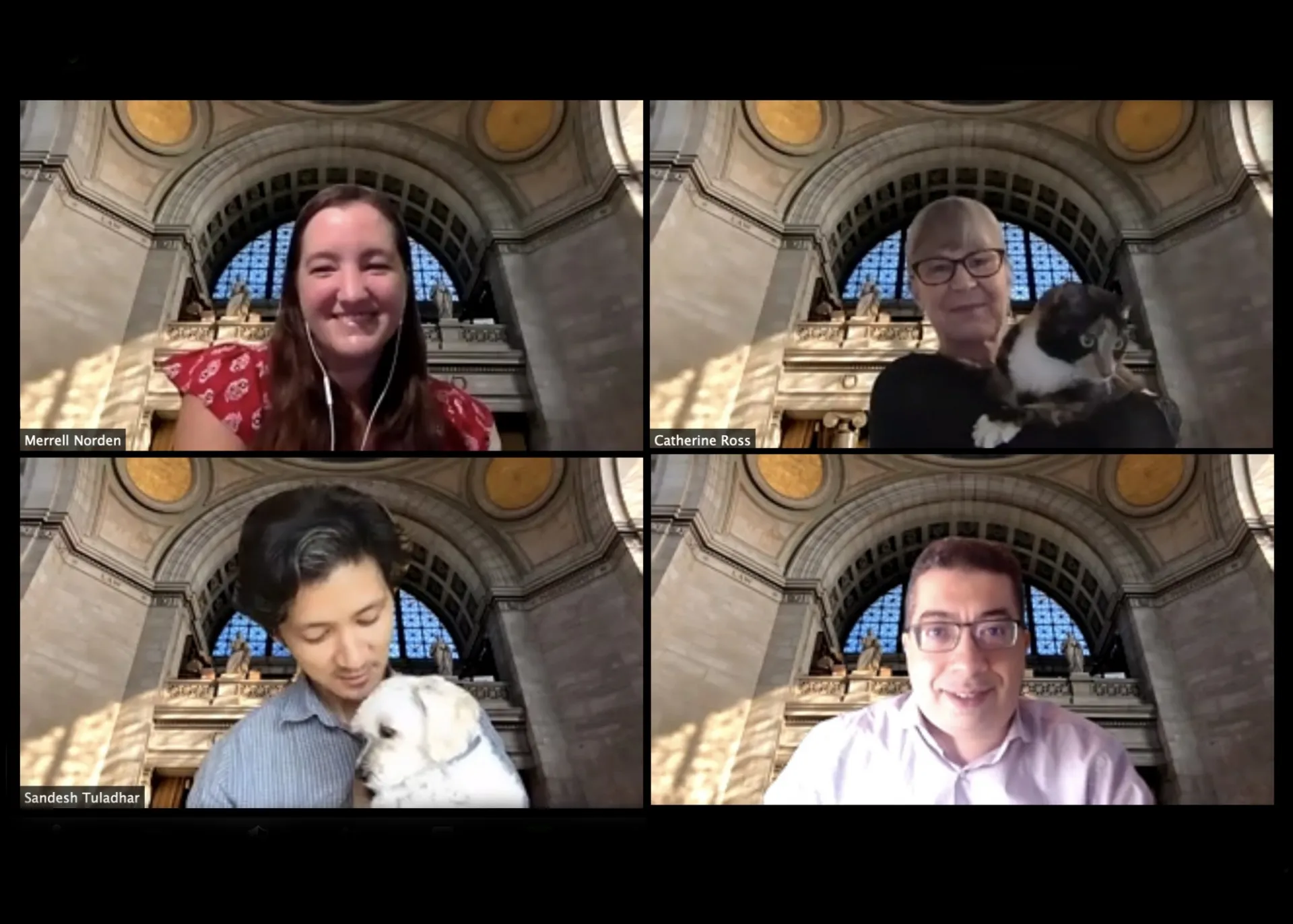
Last March, days after the first COVID-19 case was identified in New York, and the first member of the Columbia community was quarantined for possible COVID-19 exposure, each Columbia dean was faced with a challenging series of questions from the Office of the Provost: What percentage of your school’s courses could you move online by Monday? By Wednesday? By the end of the week?
While deans addressed this on a school-by-school basis, the Office of the Vice Provost for Teaching, Learning, and Innovation was considering this challenge on a University-wide scale.
For years, this arm of the Office of the Provost had been building the University’s educational technology infrastructure and pushing pedagogical innovation. On the educational technology front, it led efforts with CUIT to introduce three critical tools that made the March 2020 transition to online possible: Canvas (the University’s learning management system) in 2014, Panopto (the University’s video hosting solution) in 2016, and Zoom in 2018. Since 2014, it had funded more than 200 teaching and learning grants to incorporate new technology and educational methods into classrooms, had advanced scholarship on teaching and learning through SOLER, and had opened the doors to Columbia classes to over 4 million learners from around globe through 60 Massive Open Online Courses.
Perhaps most important to instructors, it had offered resources to incorporate new strategies and technologies into the classroom through the Center for Teaching and Learning. But the true importance of the team’s work was never more apparent than it became when classrooms first shuttered.
“The Columbia Center for Teaching and Learning transitioned from serving as an important resource for the teaching and learning community to functioning as an essential service of Columbia University,” wrote Vice Provost Soulaymane Kachani in a letter opening the 2020 Center for Teaching and Learning annual report, which offers a snapshot of the group’s work supporting the entire educational mission of the University through its transition online during the pandemic.
Throughout, the community has relied heavily on CTL resources, via many thousands of individual consultations with CTL staff, viewings of ColumbiaLearn videos on YouTube, and enrollments in CTL workshops.
The impact of the CTL will be magnified in the years to come, as the mix of online, HyFlex, and in-person classes developed for the pandemic will push the frontiers of teaching and learning long after the Columbia community is vaccinated.
Here, we recognize three colleagues who have helped the University navigate unprecedented challenges.
Catherine Ross, Executive Director, Center for Teaching and Learning
What was your role in the transition to online learning?
A lot of our work was responding quickly to the evolving needs of instructors and students throughout the pandemic, with a focus on generating feedback on the transition to remote learning, because this will inform our future CTL support work.
What was the greatest challenge you faced?
The sheer number of instructors who were looking to the CTL to help them navigate the previously unimaginable task of teaching remotely, and the short time frame within which this had to happen, was a major challenge.
People were a bit panicked but the CTL, with help from our CUIT colleagues, managed to get everyone the information they needed initially to keep teaching, and later on to enhance their teaching from one semester to another. I am extremely proud of the staff for all they accomplished.
They were amazing and extraordinarily responsive in an all-hands-on-deck kind of way. I am so grateful for their expertise and willingness to jump right in.
How has this experience affected you personally and professionally? What lessons do you think it taught the University?
Personally, given the fact that I caught the virus and was quite sick for almost two weeks, it has reminded me to stay focused on what is important in life, and that personal resilience and a willingness to work in and embrace situations that hold unknowns and ambiguities is a key strength for working in today’s higher education.
As for what the University faculty and administrators learned—they now know what a center for teaching and learning can do for an institution. This will not be the only disruption so the skills we can provide for instructors now will make them and the University more agile and better at thinking forward to future needs.
Sandesh M. Tuladhar, Assistant Provost for Online Education
What was your role in supporting online education during the pandemic?
My role has involved a great deal of work coordinating, collaborating, and managing projects. In many ways, I feel I have been responsible for connecting the many dots that make up the magical place that is Columbia University!
In the transition to online classes, I huddled many times a day with the CTL, CUIT, A&S departments, the professional schools, and groups of IT and academic technology leaders from across Columbia.
In groups like that, we brainstormed solutions to online education problems, tested ideas, and worked to disseminate decisions and best practices.
It was a total group effort, and it was lovely to see everyone come together: our office including the CTL, CUIT, entire departments, and of course, faculty, who had to prepare to teach in a remote format in a very short period of time.
What was the greatest challenge you faced?
We worked days and nights and weekends for months because things were moving very quickly, many decisions needed to be made and a lot of resources needed to be developed and disseminated.
Even though we are Columbia, and we have more resources than many other universities, at times, it still felt a little like we were fighting for the University. I believe Columbia has really shined in this moment and it has been wonderful to see everyone come together.
Has working from home in the pandemic changed the way you do work? How has it affected the way you work with colleagues?
Fortunately, our colleagues don’t really seem that distant thanks to Zoom and other communications channels, and I’ve definitely adjusted to working remotely although I have also enjoyed going to the office frequently. Also, my dog has zero complaints when my wife and I work from home, and it will be hard on her once things return to normal.
I miss having more spontaneous conversations and going on coffee runs.
Merrell Norden, Assistant Director of Online Education
What was your role in supporting online education during the pandemic?
Like Sandesh, a great deal of the effort was coordinating teams, managing many tasks at once and connecting the dots. During the early days, one of my most significant projects was moving all of our bootcamps online with less than 24 hours’ notice. And amidst all the adjustments over the past year, we even launched an online coding bootcamp for high school students, since so many of their normal summer activities were cancelled.
What was the greatest challenge you faced?
There have been many challenges, but one that stands out to me is when, in March 2020, we had to quickly put together a detailed manual for administrators and faculty leaders, with step-by-step instructions to centralize the scheduling of nearly 10,000 courses on Zoom.
This guide took several days to put together, and we consulted a lot of folks around the University and at peer institutions to get it right. We were just so happy that it was useful for the many school and departmental administrators and faculty in making the quick transition to remote education just before spring break.
Has working from home in the pandemic changed the way you do work? How has it affected the way you work with colleagues?
Before we went remote, my team had plenty of Zoom meetings from Low Library with Ed Tech partners and peer institutions, so in some ways, remote work didn’t feel like a huge change.
But I did get a change of scenery— shortly after the lockdown, I drove down to stay with family in Alabama, and the month or so I spent with them—and the five animals in the house— was the most time I’ve spent with them in nearly 10 years.
I have also enjoyed coming to campus from time to time and I look forward to reconnecting with the rest of the Office of the Provost later this summer.